


Why Is Your AC Leaking Water? Common Causes and Solutions
Contents
Why AC Leaking Water Should Never Be Ignored
1. Blocked AC Drain Pipe
2. Frozen Evaporator Coil
3. Dirty or Clogged Air Filter
4. Damaged or Overflowing Drain Tray
5. Incorrect AC Installation
6. Refrigerant or Mechanical Problems
7. Leaking AC Pipe Connections
8. Excessive Condensation in Humid Weather
What Should You Do When Your AC Starts Leaking Water?
When Should You Call an AC Technician?
How to Prevent AC Water Leakage in the UAE
Conclusion
Why AC Leaking Water Should Never Be Ignored
A few drops from the outdoor drain pipe are normal. An air conditioner removes moisture from the air as it cools, and that moisture, called condensate, is meant to leave the system through a drain line. When water drips from the indoor unit, runs down a wall, or pools on the floor, something has gone wrong.
AC leaking water is a warning sign, not a cosmetic problem. Left alone, it can stain ceilings, damage paint and flooring, and create damp conditions that encourage musty smells. In the UAE, where systems run for long hours and humidity is high near the coast, the problem can appear quickly and get worse over a single summer.
As a rule, normal condensation leaves through the drain pipe outside and the indoor unit stays dry. Abnormal leakage shows up as dripping from the indoor unit itself, wet walls or ceilings, ice on the coil, or water that keeps appearing after the AC has been switched off.
This guide explains eight common causes, how to recognize each one, which checks are safe for homeowners, and when to call a technician. Use it to separate normal condensation from a fault that needs attention.
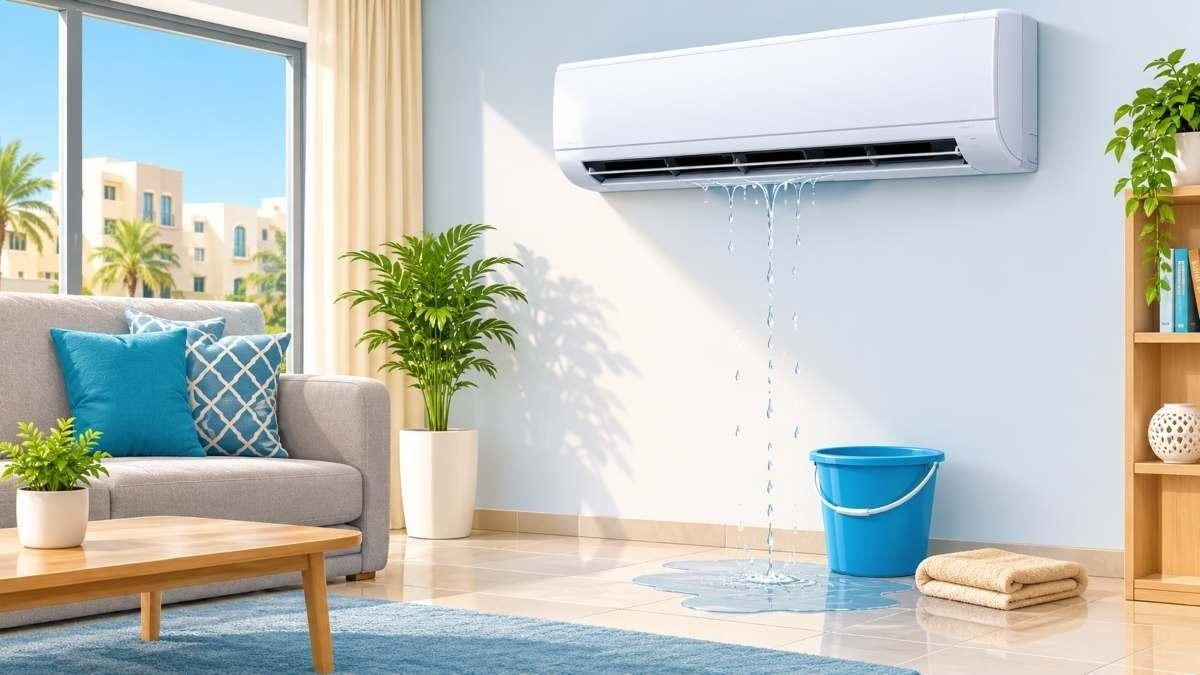
An indoor split AC dripping water onto the floor, with a bucket and towel ready nearby.
1. Blocked AC Drain Pipe
How dust and dirt block the drain line
Dust that gets past the filter mixes with moisture and forms a slimy film inside the condensate line. Over time it builds into a blockage, so water backs up in the drain pan and spills out of the indoor unit.
Signs of a blocked condensate drain
Look for steady dripping from the bottom of the indoor unit, water stains on the wall below it, a musty smell, or very little water coming out of the outdoor drain end during operation.
Why professional drain cleaning may be necessary
A technician can clear the line with suitable equipment and check the slope and connections at the same time. Forcing objects into the pipe can damage it, so avoid improvising.

A cutaway view of a condensate drain pipe blocked by dust and debris, with water backing up behind it.
2. Frozen Evaporator Coil
How restricted airflow can cause ice formation
When too little warm air flows across the evaporator coil, the coil becomes colder than it should and moisture freezes on its surface. A dirty filter, blocked vents, or a weak blower are common triggers.
What happens when the ice melts
Once the system is switched off or the ice starts to thaw, a large amount of water drains at once. The drain pan cannot always cope, so it overflows and the water runs out of the unit.
Why the underlying problem needs inspection
Simply defrosting the coil treats the symptom. If ice returns, the cause, such as airflow or refrigerant, needs to be found and fixed.

A frozen evaporator coil melting, with meltwater overflowing the drain tray.
3. Dirty or Clogged Air Filter
How dirty filters affect airflow
A filter loaded with dust restricts the air entering the unit. The coil gets too cold and the system works harder to deliver less cooling.
Relationship between poor airflow and water leakage
Reduced airflow is a leading reason for coil freezing, and a frozen coil is a leading reason for overflow. A neglected filter therefore starts the chain that ends in a leak.
Recommended filter maintenance
The U.S. Department of Energy advises cleaning or replacing filters every month or two during the cooling season. In dusty conditions, check them even more often and follow the manufacturer’s instructions.
4. Damaged or Overflowing Drain Tray
Purpose of the condensate collection tray
The drain tray, or drain pan, catches the moisture that forms on the coil and guides it toward the drain line. If it cannot hold or move water properly, the water has nowhere to go.
Cracks, corrosion and improper positioning
Older trays can crack or corrode, and a tray that sits slightly out of position may spill over one edge. Dirt buildup can also block its outlet.
Signs of drain tray damage
Water appearing along one side of the unit, rust or moisture marks beneath it, or leaks that continue even though the drain pipe is clear all point toward the tray.
5. Incorrect AC Installation
Incorrect indoor unit positioning
Most indoor units are designed to sit level or with a slight tilt toward the drain side. If the unit is mounted poorly, water can collect on the wrong side and drip into the room.
Improper drain pipe slope
Condensate drains by gravity, so the pipe must slope downward all the way to its outlet. A flat or uphill section holds water and encourages blockages.
Loose or poorly connected drainage pipes
Pipes that were not fitted or sealed correctly can leak at joints, especially after vibration or movement. If leaks began soon after installation or repair work, ask for the work to be checked.
6. Refrigerant or Mechanical Problems
How refrigerant-related faults can contribute to coil freezing
Low refrigerant lowers the pressure in the system and can make the coil colder than intended. Ice forms, then melts into the drain tray and causes a leak.
Warning signs that require professional diagnosis
Warm air despite constant running, hissing sounds, oily residue on pipes, or coils that keep freezing all suggest a fault beyond normal maintenance.
Why refrigerant handling should be left to qualified technicians
Refrigerant systems are sealed and pressurized. Checking and repairing them needs trained technicians and proper equipment, so do not attempt it yourself.
7. Leaking AC Pipe Connections
Loose or damaged drainage connections
Joints, bends, and flexible sections of the drain line can loosen or crack over time. Water then escapes before it reaches the outlet.
Water around balconies and outdoor units
Damp patches on a balcony floor, a wall below the pipe route, or around the outdoor unit can indicate a leaking connection rather than a fault inside the unit.
When pipe inspection is required
If the indoor unit is dry but you still find water along the pipe route, ask a technician to inspect the full length of the line.
8. Excessive Condensation in Humid Weather
How humidity increases condensate production
The more moisture in the air, the more water the coil must remove. On very humid days, the drain line carries far more water than usual, and any weakness in it shows up quickly.
Why coastal UAE properties may experience more condensation
Homes near the coast, including in Ras Al Khaimah, can experience higher humidity than inland areas, which often means more condensate during summer.
Importance of proper drainage
A clear, correctly sloped drain handles heavy condensation without problems. If a unit only leaks on the most humid days, the drain is probably close to its limit and needs checking.
Quick Reference: Causes of AC Leaking Water and First Checks
Use this table to match what you see with the most likely cause and a safe first step.
|
Cause |
What you may notice |
Safe first step |
|---|---|---|
|
Blocked drain pipe |
Dripping below the unit, little water at the outdoor outlet |
Switch off; call a technician for drain cleaning |
|
Frozen evaporator coil |
Ice on the coil, weak cooling, water when it thaws |
Switch off and let it thaw; check the filter |
|
Dirty air filter |
Weak airflow, dust on the filter |
Clean it per the manufacturer’s instructions |
|
Damaged drain tray |
Water along one side, leaks despite a clear pipe |
Switch off; book an inspection |
|
Incorrect installation |
Leaks soon after fitting or repair |
Ask the installer to recheck slope and position |
|
Refrigerant or mechanical fault |
Warm air, hissing, repeated freezing |
Switch off; call a qualified technician |
|
Leaking pipe connection |
Damp patches along the pipe route or balcony |
Note where the water appears |
|
Heavy humidity |
Leaks only on very humid days |
Check drain flow; arrange maintenance |
What Should You Do When Your AC Starts Leaking Water?
Act quickly but carefully. Water and electricity are a dangerous combination.
-
Switch off the AC if the leakage is significant or ice is visible.
-
Keep away from wet electrical areas, sockets, and cables.
-
Place a bucket or towels under the leak and observe where the water is coming from.
-
Check the accessible air filter according to the manufacturer’s instructions.
-
Do not open electrical components or attempt refrigerant repairs.
Take a quick photo of the leak and note when it started and whether the AC was running. This helps a technician pinpoint the cause faster, especially if the problem comes and goes.

A homeowner switching off a leaking AC and catching the water with a bucket and mat.
When Should You Call an AC Technician?
Some leaks need a professional diagnosis. Book a technician if you notice:
-
Continuous water dripping that does not stop after basic checks.
-
Water leaking through ceilings or walls.
-
Frozen evaporator coils, especially if they return.
-
Repeated drainage problems.
-
Water near electrical components.
A qualified technician can trace the source, clear or repair the drainage, and test the system afterward. Choose a provider that explains the cause and the repair before starting work.
How to Prevent AC Water Leakage in the UAE
Most leaks are preventable with a simple routine:
-
Clean or replace filters as recommended, more often in dusty periods.
-
Schedule professional maintenance, ideally before summer begins.
-
Keep accessible drain outlets clear of dirt, leaves, and obstructions.
-
Address unusual moisture and damp patches early.
-
Arrange an inspection after installation or repair work.
The U.S. Department of Energy’s air conditioner maintenance guide notes that clogged drain channels prevent a unit from reducing humidity and the excess moisture may discolor walls or carpet, which is a good reason not to postpone drain checks.
A simple monthly habit helps: check the filter, look under the indoor unit for damp marks, and glance at the outdoor drain end while the AC is running. Catching a slow drip early is far cheaper than repairing water damage later.
Conclusion
AC leaking water usually comes down to a handful of causes: a blocked drain, a frozen coil, a dirty filter, a damaged tray, poor installation, refrigerant faults, leaking connections, or heavy humidity. Early diagnosis and safe handling keep a small leak from becoming a costly repair.
If your system keeps dripping or you are unsure of the cause, the team at HomeFix UAE can inspect the AC, find the source of the leak, and recommend the right repair.


