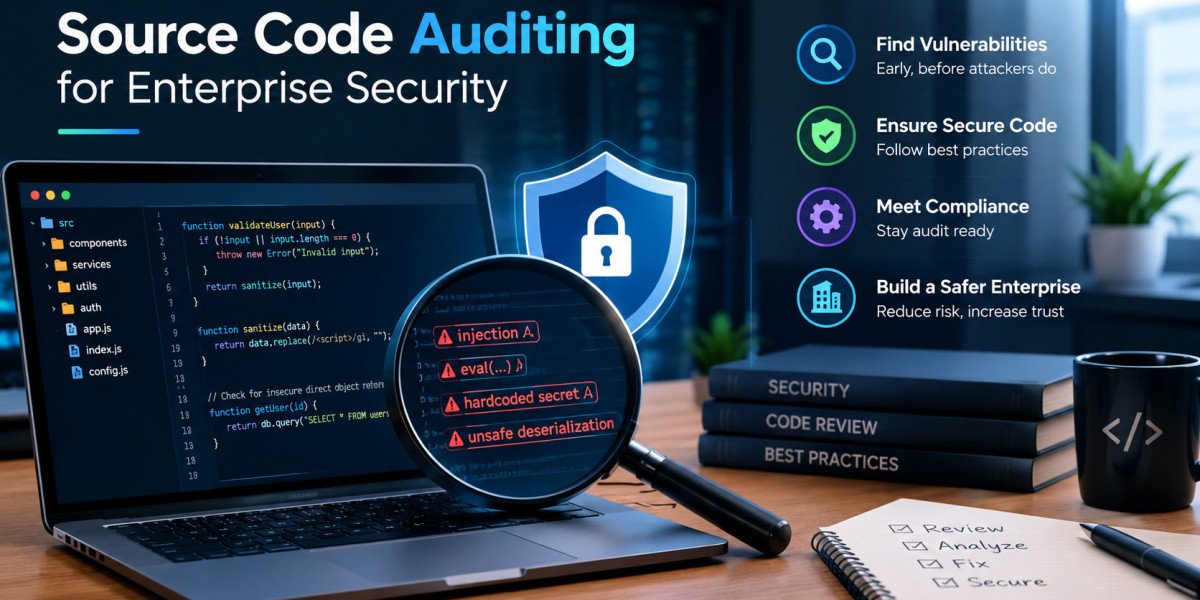

Enterprise source code auditing is a program, not a project. Inventory your applications, tier them by business risk, assign each tier a review depth and cadence, combine automated static analysis with targeted manual review track a handful of metrics such as coverage, time to remediate recurring weakness types. Standards like OWASP guidance and CWE give auditors a shared language training that closes the loop by reducing repeat findings.
A single heroic review of one critical application is valuable, but it does not scale. Large organizations ship hundreds of services, inherit acquired codebases, depend on external contractors and now accept code produced with AI assistance. The question for a security leader is not can we review this application? But how do we make sure the right code gets the right scrutiny every release?This article is written for security managers, engineering directors, application security leads who need to turn source code auditing into a dependable capability. It covers scoping, tiering, standards, pipeline integration, metrics, governance and the failure modes that quietly undermine programs. It deliberately avoids repeating the step by step reviewing technique found in our secure code review guide, which is better suited to the reviewers themselves.
Why Source Code Auditing Belongs in a Software Security Assessment
A software security assessment usually combines several activities, architecture review, threat modeling, dynamic testing, dependency analysis, configuration checks and source code auditing. Each looks at the same system through a different lens and each finds things the others cannot. Code auditing earns its place because it sees that runtime testing cannot easily reach every branch of authorization logic, dormant administrative functions, error paths, hidden test endpoints and secrets embedded in files. It also produces findings with precise locations, which shortens remediation.
Application security testing that skips codelevel review often leaves defects that only appear when an attacker finds an unusual path. The goal of auditing is not a perfect, zerodefect codebase. The goal is to reduce the likelihood and impact of exploitable weaknesses in the systems that matter most to be able to demonstrate that reduction to leadership, customers auditors.
Step One Build the Inventory You Probably Do Not Have
Programs fail early when nobody can answer what code do we actually run? Build or refresh an inventory that records, for each application owner, business function, technology stack, deployment exposure, data classification, repository location, release frequency whether the code is developed inhouse, by a vendor, or inherited.
Include the awkward categories of internal tools that became customerfacing, forgotten microservices, scripts that run with elevated privileges, mobile clients infrastructure as repositories. Shadow applications are frequently where the worst defects survive. Treat the inventory as a living artifact tied to your repository platform, not a spreadsheet that goes stale after the kickoff meeting.
Step Two Tier Applications by Risk
Not every application deserves a week of expert attention. A tiering model lets you spend scarce reviewer time where it reduces the most risk.
Define the criteria in writing and review them with business owners, because tier disputes are really risk acceptance conversations. Revisit tiers when an application gains new data, new exposure, or new integrations. For help deciding which systems deserve protection first, our article on smart security for systems offers a practical way to think about priorities.
Step Three Adopt Standards So Auditors Speak the Same Language
Without shared standards, two auditors will review the same service and return incompatible reports. Anchor your program to recognized references
OWASP Code Review Guide structured guidance on reviewing code by vulnerability type and technology.
OWASP Secure Coding Practices a compact requirements checklist developers can follow while writing code.
OWASP ASVS a verification standard that defines security requirements by assurance level, useful for deciding what adequate means per tier.
CWE (Common Weakness Enumeration) a catalog of weakness types used to classify and trend findings, such as CWE89 for SQL injection or CWE798 for hardcoded credentials.
Translate these into your own internal secure coding standard, with language specific examples and approved libraries for tasks such as input validation, cryptography secrets handling. A standard that engineers can apply without interpretation reduces both defects and arguments. For the broader set of habits that sit alongside these standards, see our web security best practices.
Step Four Combine Automated and Manual Auditing Deliberately
The practical pattern is layered. Run static analysis and secret scanning on every pull request so that common defects never reach a human reviewer. Reserve expert time for the places machines handle poorly authentication and session design, multistep workflows, permission models, payment logic, cryptographic implementations, anything that parses untrusted formats. If you are still choosing a technology for the automated layer, our overview of source code auditing and review tools can help you frame the evaluation.
Two cautions apply. First, tune scanners before enforcing them. A flood of low value alerts trains engineers to ignore the tool. Start in reporting mode, suppress verified false positives with documented justification only then block merges on highconfidence, highseverity findings. Second, never let a clean scan stand in for an audit of critical logic. A passing scan tells you the tool found no matches for the patterns it knows.
Step Five Integrate Auditing Into the Delivery Pipeline
Codelevel security checks work best when they sit inside the paths developers already use.
Pull request stage automated analysis, secret detection dependency checks, with results shown as inline comments.
Required reviewers for sensitive paths use code ownership rules so that changes to authentication, authorization, cryptography payment modules automatically request a securityaware reviewer.
Merge gates block only on defined criteria, such as confirmed critical findings or exposed credentials provide a documented exception path.
Release checkpoints for Tier 1 applications, require evidence that planned audit activities were completed before launch.
Periodic deep audits schedule manual reviews of critical modules independent of release cadence, because slowmoving risk accumulates.
Ensure the process is visible to engineers. Findings routed into the same tracker the team already uses are fixed faster than findings delivered as PDF reports weeks later.
Step Six Define Remediation Service Levels and Risk Acceptance
Findings without deadlines become a permanent backlog. Establish severity definitions and remediation targets, for example faster timelines for critical and high issues. Equally important, create a formal risk acceptance process when a team cannot fix something in time, a named business owner records the reason, compensating controls an expiration date. That keeps exceptions visible and reviewable rather than silently ignored. Verification matters as much as discovery. Require that fixes be rereviewed, because partial fixes are common. A developer who blocks one malicious string while leaving the underlying injection path open has created false assurance.
Step Eight Close the Loop With Training and Security Champions
Auditing finds defects, but only education prevents them. Use your trend data to target training, rather than delivering generic courses to everyone. If broken access control dominates findings, run handson exercises on authorization logic. If hardcoded secrets keep recurring, fix the tooling and teach secure secret handling at the same time. Security champions, developers in each team with extra training and a direct line to the security group, multiply your capacity. They triage findings, answer routine questions and raise architectural concerns early.
Our guide to effective enterprise security training explains how to structure programs that change behavior. Our application security training for developers article covers what individual engineers need. Handson practice is especially effective for audit skills. Teams can work through the source code review labs, compete on the challenges library and use the web security CTF labs to see how codelevel weaknesses are exploited. Internal reviewers who understand attacks write better findings; developers who have exploited a flaw rarely reintroduce it.
Special Cases Enterprises Cannot Ignore
Third party and contractor code. Contractually require delivery of source or a right to audit apply the same tiering model. Code you did not write still runs with your credentials and your customers data.Acquired and legacy systems. Start with inventory and secret scanning, then focus manual effort on authentication and datahandling modules before attempting a full audit.
APIs and microservices. Authorization defects cluster at object and function level, so audit every route that accepts an identifier. Our explanation of API security and OWASP risks is a useful reference for reviewers.AIassisted code. Generated code can look polished while hiding insecure defaults. Applying the same review standards make sure authors understand the code they submit.Compliance evidence. Keep records of scope, methods, findings, remediation retesting. Auditors and customers care about demonstrable processes as much as outcomes.
Common Reasons Programs Stall
Programs tend to fail for predictable reasons, no inventory, so coverage is unknowable; tools enforced before tuning, so engineers revolt; reports delivered outside developer workflows; no remediation deadlines; metrics that reward activity instead of risk reduction; and training disconnected from real findings. Each is fixable addressing them in the order above gives the program momentumA final reminder for leaders auditing complements other disciplines, including threat modeling, secure design runtime testing.
Conclusion
Enterprise source code auditing succeeds when it is treated as an operating capability. Inventory your applications, tier them by risk, give each tier a defined depth and cadence layer automated analysis under targeted manual review. Anchor the work to recognized standards, embed it in developer workflows, set remediation deadlines and measure outcomes that reflect real risk. Then feed what you learn back into training so that the same weaknesses stop reappearing. Done consistently, auditing moves from a periodic scramble to a steady source of assurance for engineers, executives, customers, regulators alike. It works best as one layer in a broader strategy of web application security; you can explore the full set of training and practice resources from the AppSecMaster home page.
Frequently Asked Questions (FAQs)
What is source code auditing in an enterprise context?
Source code auditing is the systematic examination of an organization's application code to identify security weaknesses, verify that secure coding standards are followed and produce evidence of due diligence. In an enterprise, it is run as a repeatable program with tiering, defined depth, remediation deadlines metrics rather than as an occasional onetime exercise.
How often should enterprise applications be audited?
Frequency should follow risk. Critical, internet facing systems warrant automated analysis on every change, focused manual review for significant releases and a deeper audit at least annually. Lower risk applications can rely mostly on automated checks and be audited on a longer cycle or when major changes occur.
Can automated tools replace manual source code auditing?
No. Automated analysis offers broad, consistent coverage and catches many known patterns, but it handles business logic, authorization design context poorly. Manual auditing by trained reviewers is essential for critical modules. The two approaches work best together, with automation handling volume and humans handling subtlety.
Which standards should an auditing program follow?
Most programs combine OWASP resources, including the Code Review Guide, Secure Coding Practices ASVS, with CWE for classifying findings. These provide a common vocabulary and defined requirement levels. Many organizations also translate them into an internal secure coding standard with language specific guidance.
How do we know whether our auditing program is working?
Look at trends rather than activity. Coverage of critical applications, time to remediate by severity, the number of defects discovered after release, the frequency of repeat weakness types all show whether risk is falling. If the same categories keep appearing, adjust training, shared libraries, or secure defaults rather than simply adding more scans.